 Add to Chrome
 Add to Firefox
 Add to Edge
A physics-informed foundation model for quantitative diffusion MRI
May 29, 2026
Understanding the human brain requires access to its microscopic tissue architecture. Diffusion magnetic resonance imaging (MRI) provides the only noninvasive window into whole-brain microstructure in vivo, yet reliable quantitative mapping remains confined to specialized research settings requiring dense sampling and optimized acquisition protocols. To address this gap, we present a physics-informed generative microstructure network (PIGMENT) that learns a universal generative prior of human brain microstructure and adapts it zero-shot to each participant's measured data to recover subject-specific maps. Trained on 11375 scans spanning multiple sites, vendors, and field strengths, PIGMENT enabled reliable quantitative mapping for tensor, kurtosis, and NODDI models across external datasets from five independent centers. It remains effective where conventional fitting becomes unreliable, recovering meaningful maps from extremely sparse acquisitions while supporting downstream tractography and structural connectivity mapping. PIGMENT estimates demonstrated strong biological validity, preserving submillimeter cortical microarchitectural patterns and early-childhood white matter developmental trajectories from 10-fold accelerated scans. Furthermore, PIGMENT enables reliable quantitative tensor mapping on cost-efficient low-field systems and the extraction of tumor-related biomarkers using ultra-fast clinical protocols. Together, these results establish PIGMENT as a physics-informed foundation model that extends quantitative diffusion MRI into regimes traditionally too sparse, heterogeneous, or clinically constrained for reliable analysis.

Towards Reliable Fetal Ultrasound Interpretation with Multi-Agent Collaboration
May 25, 2026Automated fetal ultrasound interpretation requires a workflow from visual perception, including plane recognition and anatomical segmentation, to clinical understanding, including biometric measurement and diagnostic reporting. However, the prevailing "one-task, one-model" paradigm limits systematic integration of evidence across this multi-step process. Although multimodal large language models (MLLMs) show promising visual understanding, their limited domain-specific grounding and hallucination risks restrict reliability in fetal ultrasound analysis. To address these limitations, we propose FetUSAgents, a tool-augmented multi-agent system for comprehensive fetal ultrasound interpretation, supporting visual question answering (VQA), report generation, image captioning, and video summarization. FetUSAgents coordinates task-specific visual tools through collaborative LLM agents and decomposes clinical queries into subtasks that progress from anatomical recognition to quantitative measurement. We further introduce Dual-Path Evidence Arbitration (DPEA), which integrates LLM-based deliberative reasoning with structured computational evidence from specialized visual tools. A retrieval-enhanced evidence bank consolidates intermediate findings to support traceable and clinically grounded conclusions. In addition, we construct FetUS-VQA, a dedicated VQA benchmark for fetal ultrasound, comprising 1,892 images and 3,205 question-answer pairs across 10 clinical tasks. Extensive out-of-distribution experiments show that FetUSAgents outperforms general and medical MLLMs, exceeding the strongest baseline by more than 25 percent in VQA accuracy. These results suggest a scalable route toward evidence-driven clinical assistants for prenatal imaging. Code is available.
R2AoP: Reliable and Robust Angle of Progression Estimation from Intrapartum Ultrasound
May 20, 2026Accurate estimation of the Angle of Progression (AoP) from intrapartum transperineal ultrasound is critical for objective assessment of labor progression, yet remains highly sensitive to imaging noise, boundary ambiguities, and the geometric amplification of local segmentation errors. We propose R2AoP, a reliable and robust AoP estimation framework that integrates structurally informed segmentation and confidence-guided geometric modeling to achieve stable and reproducible measurements. A three-branch local-structure-enhanced backbone improves the delineation of the pubic symphysis (PS) and fetal head (FH), while confidence-weighted contour fitting explicitly suppresses the influence of unreliable boundary points in AoP computation. To further improve performance under heterogeneous acquisition conditions, we introduce a lightweight geometry-reliable test-time adaptation strategy as an auxiliary component, enabling stable inference without target annotations. Extensive evaluations on multi-center benchmarks demonstrate consistent reductions in AoP error and boundary metrics compared with state-of-the-art AoP methods. Our source code is available at https://github.com/baiyou1234/R2AoP.
INFANiTE: Implicit Neural representation for high-resolution Fetal brain spatio-temporal Atlas learNing from clinical Thick-slicE MRI
May 11, 2026Spatio-temporal fetal brain atlases are important for characterizing normative neurodevelopment and identifying congenital anomalies. However, existing atlas construction pipelines necessitate days for slice-to-volume reconstruction (SVR) to generate high-resolution 3D brain volumes and several additional days for iterative volume registration, thereby rendering atlas construction from large-scale cohorts prohibitively impractical. We address these limitations with INFANiTE, an Implicit Neural Representation (INR) framework for high-resolution Fetal brain spatio-temporal Atlas learNing from clinical Thick-slicE MRI scans, bypassing both the costly SVR and the iterative non-rigid registration steps entirely, thereby substantially accelerating atlas construction. Extensive experiments demonstrate that INFANiTE outperforms existing baselines in subject consistency, reference fidelity, intrinsic quality and biological plausibility, even under challenging sparse-data settings. Additionally, INFANiTE reduces the end-to-end processing time (i.e., from raw scans to the final atlas) from days to hours compared to the traditional 3D volume-based pipeline (e.g., SyGN), facilitating large-scale population-level fetal brain analysis. Our code is publicly available at: https://anonymous.4open.science/r/INFANiTE-5D74
Annotation-free deep learning for detection and segmentation of fetal germinal matrix-intraventricular hemorrhage in brain MRI
May 10, 2026Background: Prenatal germinal matrix-intraventricular hemorrhage (GMH-IVH) is a leading cause of infant mortality and neurodevelopmental impairment. Manual diagnosis and lesion segmentation are labor-intensive and error-prone. Deep learning models offer potential for automation but typically require large annotated datasets, which are challenging to obtain. Purpose: To develop and validate an annotation-free deep learning framework for automated detection and segmentation of GMH-IVH on brain MRI. Materials and Methods: This retrospective study analyzed 2D T2-weighted MRI data from pregnant women collected from October 2015 to October 2023 at one hospital (internal validation) and two hospitals (external validation). Eligible participants included healthy fetuses and those with GMH-IVH. FreeHemoSeg was developed and trained using pseudo GMH-IVH images synthesized from normal fetal data guided by medical priors. Primary outcomes included diagnostic accuracy (area under the ROC curve [AUROC], sensitivity, specificity) and segmentation accuracy (Dice similarity coefficient [DSC]). A reader study evaluated clinical utility. Results: A total of 1674 stacks from 558 pregnant women were analyzed. FreeHemoSeg achieved the highest performance in both internal (sensitivity: 0.914, 95% CI 0.869-0.945; specificity: 0.966, 95% CI 0.946-0.978; DSC: 0.559, 95% CI 0.546-0.571) and external validation (sensitivity: 0.824, 95% CI 0.739-0.885; specificity: 0.943, 95% CI 0.913-0.964; DSC: 0.512, 95% CI 0.497-0.526), outperforming supervised and unsupervised methods. FreeHemoSeg assistance improved radiologists' sensitivity (from 0.882 to 0.941-1.000) and diagnostic confidence while reducing interpretation time by 16.0-52.7%. Conclusion: FreeHemoSeg accurately detects and localizes fetal brain hemorrhages without annotated training data, enabling earlier diagnosis and supporting timely clinical management.
EXACT: an explainable anomaly-aware vision foundation model for analysis of 3D chest CT
Apr 27, 2026Chest computed tomography (CT) is central to the detection and management of thoracic disease, yet the growing scale and complexity of volumetric imaging increasingly exceed what can be addressed by scan-level prediction alone. Clinically useful AI for CT must not only recognize disease across the whole volume, but also localize abnormalities and provide interpretable visual evidence. Existing vision-language foundation models typically compress scans and reports into global image-text representations, limiting their ability to preserve spatial evidence and support clinically meaningful interpretation. Here we developed EXACT, an explainable anomaly-aware foundation model for three-dimensional chest CT that learns spatially resolved representations from paired clinical scans and radiology reports. EXACT was pre-trained on 25,692 CT-reports pairs using anatomy-aware weak supervision, jointly learning organ segmentation and multi-instance anomaly localization without manual voxel-level annotations. The resulting organ-specific anomaly-aware maps assign each voxel a disease-specific anomaly score confined to its corresponding anatomy, jointly encoding lesion extent and organ-level context. In retrospective multinational and multi-center evaluations, EXACT showed broad and consistent improvements across clinically relevant CT tasks, spanning multi-disease diagnosis, zero-shot anomaly localization, downstream adaptation, and visually grounded report generation, outperforming existing three-dimensional medical foundation models. By transforming routine clinical CT scans and free-text reports into explainable voxel-level representations, EXACT establishes a scalable paradigm for trustworthy volumetric medical AI.
Adaptive Serverless Resource Management via Slot-Survival Prediction and Event-Driven Lifecycle Control
Apr 07, 2026Serverless computing eliminates infrastructure management overhead but introduces significant challenges regarding cold start latency and resource utilization. Traditional static resource allocation often leads to inefficiencies under variable workloads, resulting in performance degradation or excessive costs. This paper presents an adaptive engineering framework that optimizes serverless performance through event-driven architecture and probabilistic modeling. We propose a dual-strategy mechanism that dynamically adjusts idle durations and employs an intelligent request waiting strategy based on slot survival predictions. By leveraging sliding window aggregation and asynchronous processing, our system proactively manages resource lifecycles. Experimental results show that our approach reduces cold starts by up to 51.2% and improves cost-efficiency by nearly 2x compared to baseline methods in multi-cloud environments.
FetalAgents: A Multi-Agent System for Fetal Ultrasound Image and Video Analysis
Mar 10, 2026Fetal ultrasound (US) is the primary imaging modality for prenatal screening, yet its interpretation relies heavily on the expertise of the clinician. Despite advances in deep learning and foundation models, existing automated tools for fetal US analysis struggle to balance task-specific accuracy with the whole-process versatility required to support end-to-end clinical workflows. To address these limitations, we propose FetalAgents, the first multi-agent system for comprehensive fetal US analysis. Through a lightweight, agentic coordination framework, FetalAgents dynamically orchestrates specialized vision experts to maximize performance across diagnosis, measurement, and segmentation. Furthermore, FetalAgents advances beyond static image analysis by supporting end-to-end video stream summarization, where keyframes are automatically identified across multiple anatomical planes, analyzed by coordinated experts, and synthesized with patient metadata into a structured clinical report. Extensive multi-center external evaluations across eight clinical tasks demonstrate that FetalAgents consistently delivers the most robust and accurate performance when compared against specialized models and multimodal large language models (MLLMs), ultimately providing an auditable, workflow-aligned solution for fetal ultrasound analysis and reporting.
AnyAD: Unified Any-Modality Anomaly Detection in Incomplete Multi-Sequence MRI
Dec 24, 2025Reliable anomaly detection in brain MRI remains challenging due to the scarcity of annotated abnormal cases and the frequent absence of key imaging modalities in real clinical workflows. Existing single-class or multi-class anomaly detection (AD) models typically rely on fixed modality configurations, require repetitive training, or fail to generalize to unseen modality combinations, limiting their clinical scalability. In this work, we present a unified Any-Modality AD framework that performs robust anomaly detection and localization under arbitrary MRI modality availability. The framework integrates a dual-pathway DINOv2 encoder with a feature distribution alignment mechanism that statistically aligns incomplete-modality features with full-modality representations, enabling stable inference even with severe modality dropout. To further enhance semantic consistency, we introduce an Intrinsic Normal Prototypes (INPs) extractor and an INP-guided decoder that reconstruct only normal anatomical patterns while naturally amplifying abnormal deviations. Through randomized modality masking and indirect feature completion during training, the model learns to adapt to all modality configurations without re-training. Extensive experiments on BraTS2018, MU-Glioma-Post, and Pretreat-MetsToBrain-Masks demonstrate that our approach consistently surpasses state-of-the-art industrial and medical AD baselines across 7 modality combinations, achieving superior generalization. This study establishes a scalable paradigm for multimodal medical AD under real-world, imperfect modality conditions. Our source code is available at https://github.com/wuchangw/AnyAD.
No Modality Left Behind: Adapting to Missing Modalities via Knowledge Distillation for Brain Tumor Segmentation
Sep 18, 2025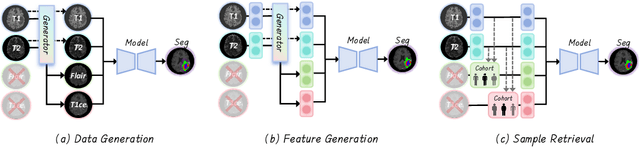
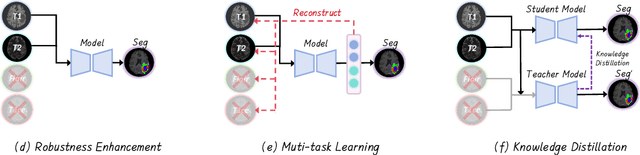
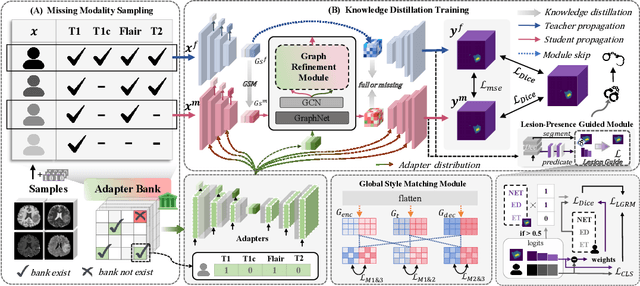
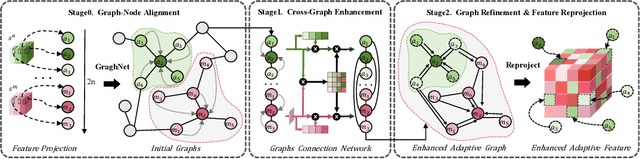
Accurate brain tumor segmentation is essential for preoperative evaluation and personalized treatment. Multi-modal MRI is widely used due to its ability to capture complementary tumor features across different sequences. However, in clinical practice, missing modalities are common, limiting the robustness and generalizability of existing deep learning methods that rely on complete inputs, especially under non-dominant modality combinations. To address this, we propose AdaMM, a multi-modal brain tumor segmentation framework tailored for missing-modality scenarios, centered on knowledge distillation and composed of three synergistic modules. The Graph-guided Adaptive Refinement Module explicitly models semantic associations between generalizable and modality-specific features, enhancing adaptability to modality absence. The Bi-Bottleneck Distillation Module transfers structural and textural knowledge from teacher to student models via global style matching and adversarial feature alignment. The Lesion-Presence-Guided Reliability Module predicts prior probabilities of lesion types through an auxiliary classification task, effectively suppressing false positives under incomplete inputs. Extensive experiments on the BraTS 2018 and 2024 datasets demonstrate that AdaMM consistently outperforms existing methods, exhibiting superior segmentation accuracy and robustness, particularly in single-modality and weak-modality configurations. In addition, we conduct a systematic evaluation of six categories of missing-modality strategies, confirming the superiority of knowledge distillation and offering practical guidance for method selection and future research. Our source code is available at https://github.com/Quanato607/AdaMM.